


From Ecuador to Europe, young practitioners share their lessons on reframing markets, governance and knowledge structures, offering concrete pathways for agrifood systems transformation.
When the ovens heat up in Ecuador's Manabí province, Sofía García Muguerza is doing much more than baking. Her cakes and pastries – made with seasonal fruit and Ecuador's prized cacao arriba nacional – are her way of giving added value to a region whose food culture she deeply cherishes. Her ambition is clear: to develop her business and highlight local and endemic flavours through baked goods with identity.
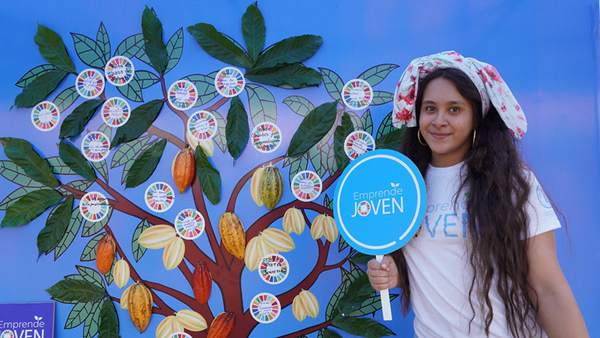
Sofía García Muguerza, a young entrepreneur from Ecuador, during the launch of the FAO-supported Agro-Youth Employment Initiative in May 2024.
Yet not long ago, the 27-year-old admitted, she was simply "in the routine", focused on selling day to day, without the tools or confidence to grow. That changed when Sofía joined a youth initiative led by Ecuador's Ministry of Agriculture, Livestock and Fisheries (MAGP) with support from the Food and Agriculture Organization of the United Nations (FAO).
"This initiative gave me the confidence to explore new spaces," she reflected. "Just like other young people who participated in the initiative, I realised I could get much more as a young person, giving added value to my products by combining local ingredients with my own identity, showing my talent and innovating."
Through the initiative, Sofía met peers from across Ecuador – coastal and Amazonian provinces alike – who were also trying to build businesses rooted in local food traditions. She began to understand the wider system she was navigating, learning how to assess market demand, survey potential customers, adapt her products, and set fair prices.
Sofía's experience illustrates an important systems insight: transformation happens when youth are placed inside relational and institutional ecosystems that amplify their agency. Her story points to the power of networks, dialogue, confidence-building, market learning and community identity – elements that are systemic, not incidental.
That insight was echoed throughout the virtual session Youth powering the transformation of agrifood systems, which brought together about 60 participants from across 16 countries. Government officials, academics, agrifood practitioners and FAO personnel joined the conversation, which also inaugurated the FAO-hosted Inter-country learning series on agrifood systems transformation. Rather than a classic, linear webinar, the 27 November dialogue moved organically between anchor stories, small groups discussions and spontaneous contributions. Ideas circulated across the room and between participants, mirroring the systems principle that learning and change do not travel in a straight line, but through multiple, interconnected pathways.
Youth pathways rooted in education and governance
Sofía's leap is not an exception in Ecuador. The country has been gradually building pathways for young people to take similar ownership of agrifood futures. As explained by Gabriela Valenzuela, Director of Management and Transfer of Innovative Agricultural Knowledge at MAGP, Ecuador faces a generational imbalance as most producers are in their 50s years old. "Our fields are getting old," she warned. This is not only about workforce renewal; it raises questions about how agronomic knowledge, food culture and territorial identity can continue being transmitted over time.
Ecuador's Government has sought to respond in ways that move beyond symbolic inclusion towards more systemic support for youth. One such effort is the network of rural entrepreneurship schools, now reaching more than 3,800 young people. The schools combine technology, business structuring and peer learning, aiming to replace isolated trial-and-error with shared practices and collective problem-solving. While still evolving, the initiative reflects an attempt to align skills development with broader institutional and territorial dynamics.
The major shift came through governance. "We don't want a top-down policy imposed on youth," said Valenzuela. "We want youth to own the governance processes that concern them." This is why the Agro-Youth Committee, created by presidential decree, translates youth priorities into institutional arrangements involving nine different public institutions structured into six thematic subcommittees: education; finance; market access; employment; sustainable production; and youth association and cooperation.
She also underscored the power of intergenerational collaboration: young farmers introduce digital tools; older farmers pass on agronomic experience. Systems transformation happens not through substitution, but through integration of roles, capacities and knowledge.
The model struck a chord among the participants. Abdelkader Ftouhi, coaching coordinator for youth-led responsible agri-entrepreneurship, FAO Agri-Accelerator Morocco, expressed appreciation for how Ecuador links youth development, policy and territorial economies. He was particularly drawn to the Agro-Youth Committee's thematic groups and suggested that a similar approach could be proposed in Morocco to boost the attractiveness and economic viability of rural enterprises.
Agroecology and youth power beyond tokenization
If the experience from Ecuador provided institutional leverage, Cristina Laurenti, Coordinator of the Agroecology Europe Youth Network, showed what systems change looks like when it is fueled from the grassroots. A nutritionist and agroecologist, she and her peers have, since 2018, built coalitions of young practitioners to promote the agroecological transition in Europe through collective learning, research and advocacy.
Their youth network – over 300 members across the continent – played a role in developing input to the European Union's generational renewal strategy, shaping concrete proposals on access to land, finance and training for the next generation of farmers in Europe. Many of these proposals, however, never appeared in the final text. Laurenti described this as a lesson in how institutions sometimes tokenize youth participation, without genuinely shifting power and shaping policies that fulfill their demands. Young people are consulted, she argued, but not fully integrated into decision-making. Funding, representation in policy spaces, and institutional coherence are essential but remain insufficient to ensure meaningful uptake of measures and perspectives shared by the most directly affected.
Confronted with what they saw as the EU's tokenization of their contribution, the youth network took that lesson and turned it inward, sharpening their approach through an exercise of critical thinking internally. They began an internal "decolonial and anti-imperialist" reflection inside Agroecology Europe, pushing the host organization to address uncomfortable questions: "What does it mean for an association working in Europe to talk about agroecology given the continent's implication in historical and ongoing colonization processes?", proving that youth voices have meaningful messages to share and are able to bring more progressive perspectives of agrifood systems transformation.
Thanks to this process, which will be formalized through a position paper, Laurenti sees a shift emerging within the organization: young agroecologists are not entering policy spaces to tick a box; they are arriving as strategic knowledge holders able to reframe debates and expose contradictions against the "political, environmental and social crises" worldwide. "We began shifting from being heard to being listened to," she reflected, adding that she now sees increased recognition of their role and influence.
What labour, markets and institutions make possible
The systemic lens resurfaced throughout the session as the floor opened to contributions. Harry Bleppony, Deputy Director of Agriculture at Ghana's Ministry of Food and Agriculture, cautioned that many youth programmes falter because they are designed for youth rather than with them – a structural flaw that treats young people as beneficiaries rather than actors. "Policies must be developed with youth, not just targeted at youth," he said. Role models, such as visible leaders in high-level political positions who farm and share their journey, can attract youth. In Bleppony's view, using youth-based organizations or institutions to promote agricultural programmes can unleash the potential in agriculture to attract the youth.
Connecting from Argentina, Griselda Muñoz, Director for Gender and Human Rights at the National University of Rosario's Faculty of Agricultural Sciences, drew attention to how labour markets shape transformation. Muñoz explained that the most remunerative and stable career opportunities for young graduates are offered by large agribusiness employers operating within the commodities export-oriented soybean belt that spans the central Pampas region in Argentina, reinforcing monoculture production and dependence on agrochemicals. For young professionals hoping to work within agroecological transition initiatives, the landscape looks markedly different. Positions in this field tend to be fewer and associated with lower wages, making it harder for graduates to pursue careers aligned with ecological principles. Transformation, she suggested, requires not moral resolve alone but structures that reward practices aligned with biodiversity, nutrition and territory.
Faviana Scorza Agüero, an agrifood systems specialist from Costa Rica, argued that this is precisely why the structure of local food markets must be redesigned. In her country, she pointed out, youth-led agroecological enterprises are unable to compete to enter traditional product chains, which are characterized by their large scale, homogenisation, and low profit margins for producers. These initiatives need to participate in the country's existing infrastructure through local markets, access differentiated sources of financing, public procurement programmes and incubators, where ecological and social values are appreciated. These are not privileges, she stressed, but structural enablers that rebalance power and bargaining capacity, and which must be supported by public policies.
As FAO co-facilitators, Laura De Matteis, Agrifood Systems Expert, and Elena Ambühl, Junior Professional Officer, kept the session anchored in reflection. "Transformation without youth is mathematically impossible," said De Matteis, citing FAO data that 1.3 billion young people – 44 percent of the global youth labour force – already work in agrifood systems. "Despite their numbers, many are invisible in decision-making, restricted by structural barriers, motivating youth movements around the world to challenge long-standing inequalities," she added.
Participants reinforced this point by highlighting the diversity within youth itself, a dimension often overlooked in agrifood policy and practice. Comments drawn from the chat stressed that young people experience agrifood systems differently depending on gender, location, education, employment status and ability. Youth with disabilities, in particular, face compounded barriers to participating in agricultural work, processing facilities and value chains, especially where "business as usual" approaches fail to adapt technologies, infrastructure and labour conditions. Others pointed to young women and informally employed youth in rural areas, whose contributions are substantial but insufficiently recognised or supported through financing, safeguarding and gender-responsive strategies.
Collective reflection and action as system tools
"Progress happens when governments, businesses, civil society, researchers and communities join forces so that we can move from planning change to actually undertaking change," said Corinna Hawkes, Director of FAO's Agrifood Systems and Food Safety Division. Change, she argued, does not arise from technical plans alone, but also from the processes they are surrounded by.
By the end of the session, there was a clear sense that youth are not a constituency to be activated but actors already reshaping agrifood systems. In Manabí, Sofía builds value with endemic cacao. Across Europe, young agroecologists build a critical mass to bring progressive views to policy debates. In Argentina and Costa Rica, young professionals confront markets that penalize sustainability. In Morocco, youth coaching programmes connect policy to territorial realities to make rural areas more attractive for business. Their actions are not peripheral – they are constitutive parts of the agrifood systems transformation.
The first dialogue was not a conclusion but the beginning of a learning journey. Each future dialogue in the series will explore a different entry point for transformation, grounded in the realities, tensions and aspirations that participants bring. Rather than a straight line of recommendations, the series is designed as a cycle of reflection, experimentation and collaborative action – an ongoing practice of systems change for each participant, individually and collectively.
"We are all part of the system. We are the ones who have to change it also through these learning spaces," stressed José Valls Bedeau, FAO Policy Officer, encouraging participants to keep the conversation active and to carry their insights back into their own institutions and territories.
Key takeaways: From planning to purpose-driven, youth-powered collaborative action
Youth are multifaceted: diversity and intersectionality must be recognized. Barriers and resources differ by geography, gender, education, ability and employment status. There is no universal solution to foster youth leadership. Actions should be implemented based on contextual realities and inspired by documented experiences from across the world.
Inter-generational integration: a promising approach replaces "generational substitution" with collaboration across generations, combining strengths and perspectives for inclusive transformation.
Transformation through ecosystems: Change occurs when youth are embedded in relational and institutional networks that amplify their agency through dialogue, confidence-building, market learning, and community identity.
Youth as influential knowledge holders: Young people bring progressive perspectives to address political, environmental and social crises. By shifting from "being heard" to "being listened to," youth participation in governance spaces goes beyond tokenism and consultation. Genuine power-sharing and integration into decision-making enables to shape policies that fulfil youth demands.
Policies must be co-created: Avoid top-down approaches. Policies and programmes should be designed with youth, not for them, treating youth as actors rather than beneficiaries. Additionally, policies should ensure pathways for youth to apply skills through access to land, financing, and value addition linkages.
Rewarding ecological and social value: Transformation requires structural enablers that reward practices aligned with biodiversity, nutrition and territory. Food market architecture and policies must be redesigned to support youth-led agroecological enterprises via territorial markets, cooperative financing, public procurement, and incubators.



wydf@wydf.org.cn

