


If 2025 has been the year of AI hype, 2026 might be the year of AI reckoning. Here are five contradictions or paradoxes emerging as AI is adopted, which may reveal less about the technology per se than the idiosyncrasies of the human beings using it and developing it.
Will AI Take Our Jobs or Give Us New Ones?
The World Economic Forum's 2025 Future of Jobs Report highlights demand for new roles, many of which call for skills unique to humans. And, for now at least, economic growth still seems to need big, human ideas. The report drew on a survey of more than 1,000 leading global employers, and found 170 million new roles set to be created and 92 million displaced, resulting in a net increase of 78 million jobs between 2025 and 2030.
But half of employers plan to reorient their business in response to AI, two-thirds plan to hire talent with specific AI skills, while 40% anticipate reducing their workforce where AI can automate tasks.
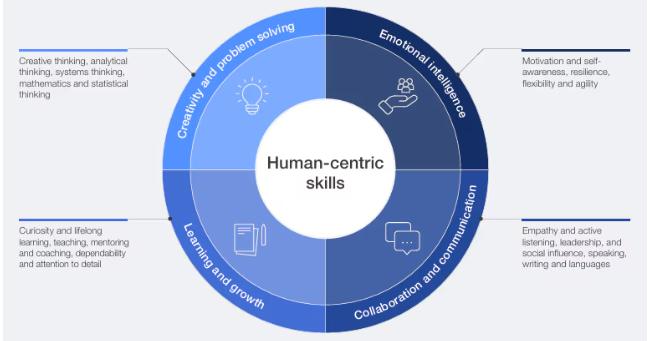
New Economy Skills: Unlocking the Human Advantage Image: World Economic Forum
Nearly two-fifths of existing skills required on the job are predicted to change over the next five years. Unsurprisingly, tech-related roles are some of the fastest growing and the skills needed to direct, oversee and evaluate AI operations are set to increase. But so too are frontline roles such as farmworkers, delivery drivers, construction workers, nursing, teaching and social work seeing significant growth.
Another recent paper, Jobs of Tomorrow: Technology and the Future of the World's Largest Workforces, emphasizes sector-specific variations. Some jobs are being automated while others are enhanced, especially those requiring complex problem-solving, interpersonal skills, and creativity.
Counterintuitively, therefore, the demand for human-centric skills may be increasing as AI adoption grows. Closing skills gaps and transitioning from declining to growing roles will be essential to growth and employment prospects.
Is AI Productivity Creating Extra Work?
According to MIT Sloan, manufacturing companies that adopt AI often experience initial productivity losses.
This is known as the productivity paradox. Research into AI adoption at US manufacturing firms found that AI introduction frequently leads to a measurable but temporary decline in performance. But this is then followed by stronger business outcomes over the longer term.
Over time, the MIT Sloan study found that organizations adopting AI tended to outperform similar firms not using AI in both productivity and market share.
For the knowledge sector, the outlook is nuanced. While workers are being encouraged to embrace AI, a recent report from the MIT Media Lab found that 95% of organizations see no measurable returns. Even worse, some workers are saying that AI is creating 'workslop'. This low-quality, AI-generated work requires unnecessary extra work.
However a recent McKinsey study reveals that for most organizations, AI use remains in pilot phases and many companies have yet to scale the technology in ways that might offer tangible results. Those that are ahead of the AI curve are reporting benefits. So the jury's out.
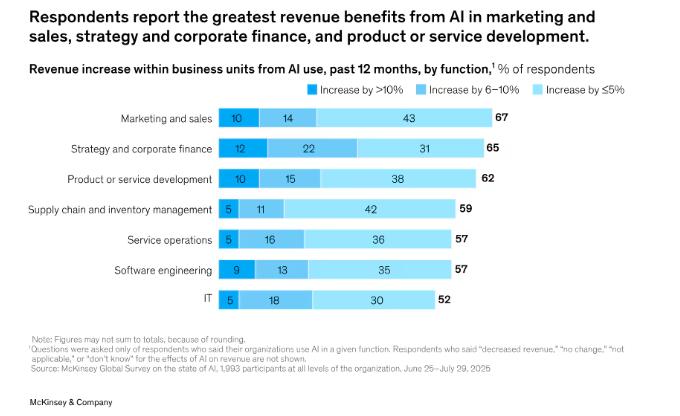
The state of AI in 2025: Agents, innovation, and transformation Image: McKinsey & Company
Will 'AI Slop' Put a Premium on Human-Crafted Content?
Large language models have rapidly become adept at creating text that is almost indistinguishable from that made by people. Generative AI tools can now create incredibly realistic audio, images and video from a simple prompt. At the same time, the amount of AI content online is exploding. Some estimates now suggest that the quantity of AI-generated articles has surpassed those written by humans.
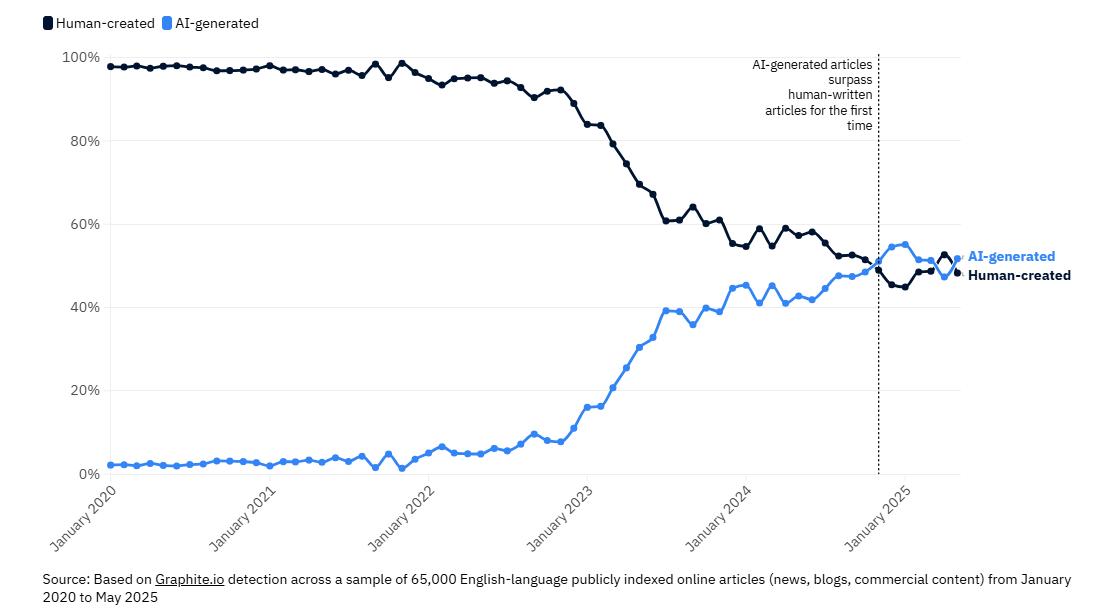
Made with Flourish·Create a chart
At best this will mean a proliferation of bland, mediocre content, or 'AI slop'. At worst, the result is a surge of false or misleading content. The number of deepfakes shared on content platforms, for example, is projected to reach 8 million in 2025, a 1,500% increase from 500,000 in 2023.
Misinformation and disinformation - which were among the top global risks for 2025, according to the World Economic Forum’s 2025 Global Risks Report - are becoming increasingly difficult to distinguish from true information. And as the information space becomes crowded with AI slop, could there be a scenario where human-crafted content from trusted individuals or platforms has a higher value?
The Forum's recent paper, The Intervention Journey: A Roadmap to Effective Digital Safety Measures makes clear that trust online doesn’t emerge automatically - it has to be earned and reinforced. That means clear signals of authenticity, accountability and human oversight may become what helps reliable information stand out.
Will the AI Generation be The Lost Generation?
Many in Gen Z are using AI, with 47% telling one US survey they use generative AI weekly. Yet, 41% say they feel anxious about the technology, and almost half are concerned it will harm their ability to think critically.
They may be right. A recent MIT study highlights "reduced brain activity, diminished memory retention, and less original thinking" as potential downsides of over-reliance on AI.
Other young people recognize how the technology could benefit them, but are worried about the effect using it will have on the planet through its water and energy use and the impact of mining for critical minerals for AI infrastructure.
A recent paper, New Economy Skills: Building AI, Data and Digital Capabilities for Growth, reveals some labour-market implications for Gen-Z. Many of the roles that once served as entry points for young workers are being reshaped or hollowed out by automation and AI-enabled tools, while the jobs that are growing often demand experience, digital fluency or specialized skills from the outset.
This leaves young people caught in a familiar bind: expected to arrive “AI-ready”, yet with fewer opportunities to learn on the job. For those without access to high-quality education, training or employer support, the risk is not just anxiety about AI, but a narrowing of pathways into stable, meaningful work.
A parallel shift is the rise of AI agents that don’t just assist with tasks but plan, coordinate and act across workflows. As the Forum’s AI Agents in Action report notes, these systems increasingly resemble human decision-makers rather than static tools.
Will AI Solutions Meet AI's Energy Needs?
AI's energy footprint is a significant challenge. By 2035, data centres in the US alone could account for 8.6% of total electricity use - more than double their current share. Globally, data centres consumed around 415 TWh in 2024 and this is expected to more than double by 2030, according to the International Energy Agency (IEA).
COP30 discussions of the “twin transition” (bringing together digital transformation and the energy transition), recognized that AI’s growth must not just meet its own power needs but also help accelerate clean energy deployment at scale.
The Forum report From Paradox to Progress: A Net-Positive AI Energy Framework says that managing AI's energy impact is no longer a future concern but a "present tense innovation imperative".
It offers a framework to help policymakers and tech executives align AI's growth with energy, economic and climate goals.



wydf@wydf.org.cn

