


Young people are increasingly recognized as essential partners in shaping the decisions that affect their lives and communities. Yet too often, youth participation in international processes remains limited or symbolic rather than meaningful.
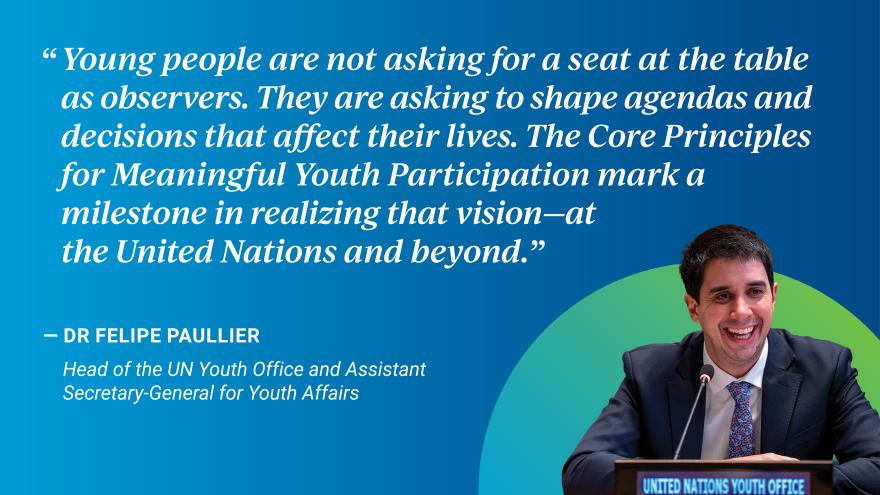
The Core Principles for Meaningful Youth Participation in Intergovernmental Processes and Across the Work of the United Nations, developed under Action 37(d) of the Pact for the Future, aim to address this challenge. Co-created through consultations with Member States, UN entities, young people and youth organizations, the Principles provide non-binding guidance to strengthen meaningful, representative, inclusive and safe youth engagement across the work of the United Nations.
A legacy of youth leadership
For decades, young people have led movements that have reshaped societies - from climate action to human rights, from peacebuilding to digital innovation. There are 2.6 billion young people between 15 and 35, and their message is clear: participation must move beyond consultation to shared decision-making.
The United Nations has evolved alongside this reality. From successive Envoys on Youth of the Secretary-General, to Youth2030, the UN Youth Strategy, foundations were laid for more coherent, system-wide engagement. While momentum grew, progress remained uneven, leaving opportunities for sustained impact to be fully realized.
The establishment of the United Nations Youth Office in 2022 (GA resolution 76/306) marked a structural shift by creating a dedicated entity to champion meaningful youth participation across the UN system and beyond.
In April 2023, UN Secretary-General António Guterres published the Policy Brief on Meaningful Youth Engagement in Policymaking and Decision-Making Processes. The Brief presented a clear rationale and framework for strengthening youth engagement, affirming a simple truth: transformative change requires sustained, inclusive and influential engagement by young people. This vision set the stage for concrete multilateral commitments, recognizing meaningful youth participation as essential for effective, legitimate and future-oriented governance.
In September 2024, the Summit of the Future and Youth Action Day at UN Headquarters brought together Member States, civil society, the private sector, academia, local and regional authorities, and youth to foster dialogue and generate commitments. The Pact for the Future, adopted by Member States through General Assembly resolution A/RES/79/1, established Action 37(d), mandating stronger meaningful youth participation in policymaking and decision-making processes.
From commitment to action
Building on the Secretary-General’s vision and the commitments made by Member States in the Pact for the Future, the UN Youth Office launched the UN Youth Compass - an evolving ecosystem designed to strengthen coherence, coordination and accountability on youth participation across the United Nations.
The Core Principles for Meaningful Youth Participation provide a concrete entry point within this ecosystem, translating shared commitments and policy ambition into practical guidance for inclusive, equitable and trust-based engagement.
Institutionalizing participation requires shared responsibility: Member States championing implementation; UN entities coordinating efforts; donors and partners supporting capacity-building and monitoring; and young people engaging as equal partners.
Together, these efforts take a decisive step toward embedding meaningful youth participation in agenda-setting, decision-making, implementation and review - strengthening the legitimacy and responsiveness of global governance.



wydf@wydf.org.cn

