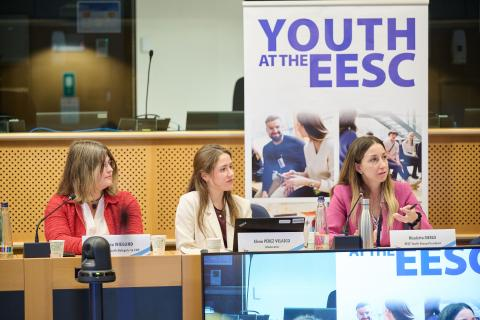
As part of the European Youth Week 2026, the European Economic and Social Committee (EESC) highlighted its long-standing commitment to meaningful youth participation through direct engagement with young people and a range of concrete policy tools designed to strengthen their influence on decision-making.
One key element of the EESC’s contribution was a breakout session on “Meaningful Youth Participation in Action!”, held on 24 April as part of the official programme. This interactive round table brought together more than 40 young participants to explore how youth participation can translate into real influence at local, national and EU levels.
Practical Tools and Pathways for Engagement
The session showcased specific EESC mechanisms to support youth engagement, including the EESC Youth Test, which incorporates young people’s perspectives in EU legislative processes, and the Youth Delegate to COP, which offers young people an opportunity to contribute directly to international climate negotiations. Youth organisations are also involved in the EESC’s work through its Climate and Sustainability Round Tables, Your Europe, Your Say!, the Liaison Group, the European Circular Economy Stakeholder Platform, country visits organised by the Permanent Group on Fundamental Rights and the Rule of Law, and other EESC events. In addition, the EESC maintains a close relationship with youth organisations from EU candidate countries. Together, these initiatives convey a clear message: at the EESC, youth participation is not a one-off initiative, but a long-term institutional commitment.
Learning from the Young People Already Shaping Policy
The round table brought together young leaders and experts already influencing policy, including Nicoletta Merlo,President of the EESC Youth Group, Sophia Wiegand, former EESC youth delegate to COP, and youth participation experts Bruno António and Françeska Muço.
The discussions were structured around two themes. The first round focused on access to decision-making spaces, examining how young people can move from engagement to real influence. Françeska Muço highlighted persistent barriers to participation, including limited understanding of youth participation, lack of trust, inadequate structures and platforms, and gaps in civic education. She stressed the need for early investment in capacity-building, better information on rights and responsibilities, and stronger recognition of youth work. Sophia Wiegand shared her experience as a youth delegate to COP26 and COP27, underlining the importance of being involved early in the process, having adequate preparation, and receiving the necessary support to access decision-makers at the highest level.
The second round of discussions addressed the distinction between meaningful and tokenistic participation. Participants stressed that tokenistic approaches often lead to frustration and disengagement when time and contributions are not reflected in outcomes. Meaningful participation, by contrast, requires early involvement, clear roles, long-term support and visible follow-up. Bruno António highlighted the transformative role that young people play in society, noting that creating change often means challenging existing structures and that political will remains a key obstacle. Sophia Wiegand added that young people should be involved in discussions on all major policy issues, not only those labelled as “youth-related”.
Concluding the discussion, Nicoletta Merlo emphasised that strengthening meaningful youth participation requires co-creation, follow-up and long-term support, including learning opportunities, training, financial resources and improved access for persons with disabilities, and for marginalised or vulnerable groups.
European Youth Week 2026
European Youth Week (EYW) is a biennial initiative co-organised by the European Commission and the European Parliament to promote youth engagement and active citizenship. The 2026 edition runs from 24 April to 1 May and focuses on “Solidarity and Fairness”, reflecting key issues raised by young people such as well-being, the cost of living, housing, employment, social inclusion, intergenerational fairness, regional disparities and climate action.