


Prioritizing child- and youth-friendly mobility is essential for supporting sustainable development, health and well-being amongst younger populations, improving traffic safety, ensuring equitable access to transport, and for addressing social, infrastructural and gender-related disparities.
A policy paper on child- and youth-friendly mobility has been prepared by the Partnership on Child- and Youth-friendly Mobility under the Transport, Health and Environment Pan-European Programme (THE PEP). It invites national policymakers to recognize the long-term value of investing in child- and youth-friendly mobility. It presents data and research findings on the mobility behaviour of children and youth and its implications; it highlights the health, safety, social and environmental benefits of sustainable, independent and active mobility; and it introduces key policy areas to support more inclusive and forward-looking transport strategies.
The challenge: inactivity and decreasing autonomy
In many UNECE countries walking and cycling to school for children and youth is the most common mode of travel, but significant disparities exist between countries and urban and rural areas.
Across countries, 41% of children aged 6–9 years actively travel to and from school – on foot, by bicycle, by non-motorized scooter or on skates. Among pupils aged 11, 13 and 15 years, walking to and from school ranges from 30% to 55%.
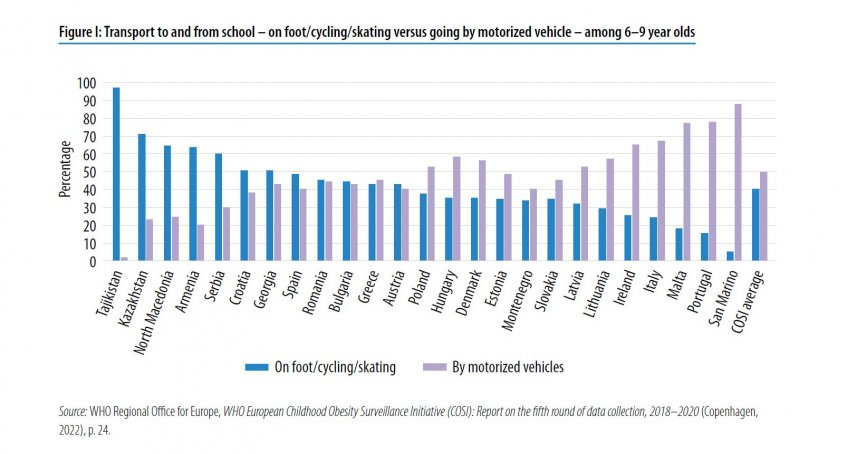
WHO and International Transport Forum (ITF) data show that, in several high-income countries, more than 40% of primary school children are regularly driven to school by car, particularly in suburban and rural areas where public transport access and infrastructure for active mobility are limited. This reliance on car transport not only limits children’s opportunities for physical activity and independent mobility but also contributes to increased traffic congestion and greenhouse gas emissions, thus negatively affecting both public health and the climate.
Globally, 80% of adolescents do not meet WHO recommended levels of physical activity. Furthermore, research indicates that the independent mobility range of children has been decreasing in recent years, with parental confidence and perceptions of safety acting as key factors influencing children’s and youths’ mobility choices. This is despite the significant progress made by UNECE Member states in reducing road fatalities for children aged under 15 years.
Overall, the data and research highlight the importance of maintaining opportunities for active mobility, even for longer school journeys that involve public transport.
Broad benefits of sustainable, autonomous and safe mobility for children and youth
Improved physical and mental health: Children and adolescents aged 5 to 17 years who walk or cycle to school are often more alert, less stressed and physically fitter;
Development of essential traffic skills and acquisition of long-term habits: Walking and cycling supports the development of skills like spatial awareness, coordination and decision making. - and they can encourage their parents to make more sustainable mobility choices;
A traffic system designed to be safer for children and youth is safer for everyone.
Independent mobility, equity, liveability: Independent mobility fosters autonomy in children and reduces burden on caregivers;
Environmental and Climate benefits: More active mobility and use of public transport contributes to reduced traffic-related emissions, improving air quality and better protecting children and youth from harmful pollutants.
Shaping the future: key policy areas
To achieve child- and youth-friendly mobility, member States need to work to establish cross-sectoral governance. Children and youth views and experiences need to be integrated into planning processes, which need to prioritize walking, cycling and public transport.
The policy paper outlines several areas for action, among which:
·Investing in infrastructure and public transport
·Participation of children and youth
·Promotion of autonomous and sustainable mobility ·Monitoring and research



wydf@wydf.org.cn

