


UNESCO/NYO
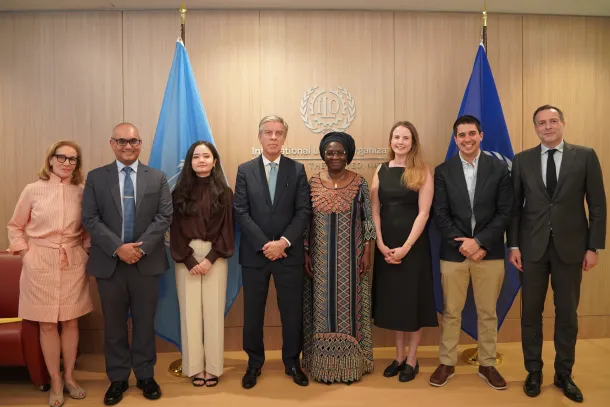
Young leaders, Member States, employers, workers, civil society and United Nations partners gathered in New York on 15 July 2026 to mark World Youth Skills Day under the theme "Skills for a Shared Future." The event explored how digital and AI literacy can be combined with creativity, critical thinking, empathy and other human-centred skills, while making education and training systems more inclusive, resilient and responsive to change through meaningful youth participation.
Representing UNESCO, Eliot Minchenberg, Director of the UNESCO Liaison Office in New York and UNESCO Representative to the United Nations, connected the future of skills to the defining challenges of climate change and technological transformation. He emphasized that equipping people with the skills to address climate change is no longer optional, but essential to building a sustainable future.
"At UNESCO, we believe that young people should not only adapt to change, but should also have the skills and confidence to shape that change."
Mr. Minchenberg highlighted UNESCO's work with countries to strengthen foundational learning, technical and vocational competencies, digital and AI literacy, critical thinking, creativity, adaptability and socio-emotional skills. He stressed that these competencies are needed not only to find employment, but also to solve problems, make informed decisions, participate in society and build a better future.
Recalling UNESCO's 2021 Recommendation on the Ethics of Artificial Intelligence, he also underlined the need to ensure that AI is developed and used responsibly, particularly as young people face risks such as misinformation, harmful content and online manipulation.
"We must make sure that innovation goes hand in hand with safety, inclusion and human rights."
Mr. Minchenberg further emphasized that young people must have a seat at the table and that their voices, ideas and experiences should inform decisions about education and the future of work. UNESCO's Global Youth and Student Consultations on Education beyond 2030 were also highlighted as an opportunity for young people to share their aspirations, priorities and proposed actions for the future of education.
The following initiatives and policy developments were highlighted by the organizers and partners, including the Representatives of Portugal and Sri Lanka to the United Nations, the International Labour Organization, and Special Envoy for Youth Affairs:
The ILO Convention concerning Decent Work in the Platform Economy: In her opening remarks, moderator Cynthia Samuel-Olonjuwon, ILO Special Representative to the United Nations and Director of the ILO Office for the United Nations, introduced the Convention as a major development in shaping a fairer future of work. Marco Perez Molina, Vice-President of the ITUC Youth Committee, later described it as a historic milestone for protecting young workers' rights in the platform economy. In closing, Ms Samuel-Olonjuwon returned to the Convention as evidence that governments, workers and employers can work through multilateralism to ensure that technology serves people.
The StepForward initiative: Annelise Dahl of the S&P Global Foundation presented StepForward as a partnership-driven effort to equip young people with the adaptability, curiosity and confidence needed to navigate an AI-enabled world, while supporting and scaling locally led solutions in collaboration with the United Nations Youth Office.
Portugal's Digital Skills Pact: Ambassador Rui Vinhas presented the Pact as part of Portugal's broader commitment to digital inclusion and lifelong learning, emphasizing the need to prepare young people for emerging fields while ensuring that no one is left behind.
Sri Lanka's national focus on TVET and digital learning: Vithanage Chatura Jeevake Perera, Deputy Permanent Representative of Sri Lanka to the United Nations, framed technical and vocational education and training as a national priority, alongside the expansion of digital learning opportunities and partnerships that provide inclusive and future-oriented skills development.
On this occasion, the Secretary-General issued a message in which he recognized young people as innovators, leaders and agents of change. The message called for greater investment in inclusive, quality education and training to close skills gaps, create decent jobs and support sustainable livelihoods.
Nila Ibrahimi, Young Leader for the SDGs and Co-founder and President of HerStory, shared how she began advocating for girls' rights in Afghanistan at age 13 by publicly challenging a ban on girls’ singing. She emphasized that meaningful change depends not only on technical skills, but also on empathy, communication, trust, courage, creativity and ethical judgement. On artificial intelligence, she stressed that AI literacy should help young people ask not only what technology can do, but what it should do.
Across the discussion, speakers emphasized that young people must be recognized not simply as beneficiaries of skills policies, but as innovators, leaders and partners in shaping them. They called for stronger investment in inclusive education and training, technical and vocational education, lifelong learning and partnerships that connect skills development with decent employment, social justice and sustainable development.



wydf@wydf.org.cn

