


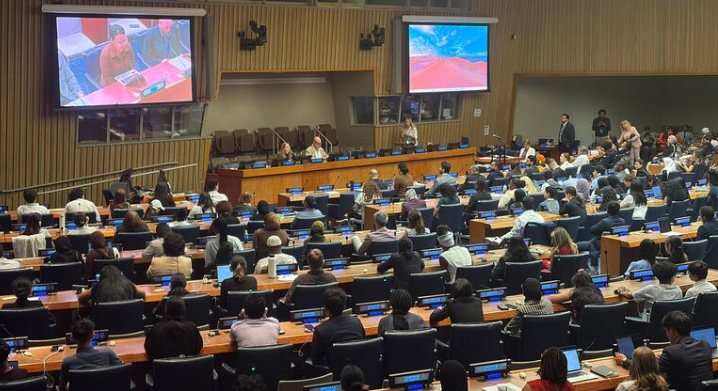
The UN hosted more than 600 young people from around the world at United Nations Headquarters in New York to discuss how AI can support the Sustainable Development Goals (SDGs).
The summit took place on International Youth Day, which has been observed annually on 12?August since 2000 to celebrate the potential of youth as partners in today’s global society.
Following a series of discussions and workshops, delegates presented a Youth-led Declaration on AI Policy and Governance. It will inform future UN-led efforts to shape global AI governance, especially the Global Digital Compact.
Underrepresented Voices
Samara Allen, a 19-year-old student at the University of California-Los Angeles, moderated the opening session — reflecting the role of young people in leading discussions around AI.
Several ambassadors and UN officials highlighted the fact that because young people will live with these impacts the longest, they must play a role in shaping the future of AI standards across the globe.
“This is not simply a conversation about technology,” Ambassador of Dominica Philbert Aaron said. “It is a conversation about power, dignity, opportunity, culture and the future we choose to build together.”
But young people were not the only marginalised group that representatives at the summit sought to empower.
With ambassadors from the Bahamas and Dominica helping to organize the summit – and with participation from Pakistan and Tonga — delegates also discussed how to ensure that developing countries are not left behind in the AI transition.
“Technological progress will not automatically translate into human progress if developing countries lack access to infrastructure, computing capacity, skills, finance and knowledge,” said Sheikh Jaffar Khan Mandokhail, governor of the Balochistan, Pakistan.
Mr. Paullier said it was “unfortunate” that AI development was controlled primarily by a few large companies based in higher-income countries, and stressed that AI governance must be inclusive.
“We want AI to help to reduce inequalities, not to deepen inequalities,” he said.
In a statement on Wednesday, UN Secretary-General António Guterres said the international day celebrates “the creativity, dynamism and leadership of young people everywhere.”
He recognised that young people face myriad challenges including economic uncertainty, digital exclusion and climate change, and stressed that the UN stands with them as they seek a greater role in decision-making processes.
Young and Jobless
Ahead of the day, the UN’s International Labour Organization (ILO) published a report finding that worldwide youth unemployment had begun to worsen again after a post-pandemic rebound, leaving millions unable to get their crucial first job.
The report further found that 6.1 percent of jobs held by young people aged 15 to 29 fall into the categories of those most exposed to AI, which could lead to millions more becoming unemployed within the next few years.
Speakers said the youth participants at the summit are some of the best positioned to ensure that AI empowers humanity and helps people learn new skills – rather than simply taking jobs.
“The future of AI should not simply happen to your generation. Your generation must actually help shape it,” Mr. Mandokhail said. “My message to you is therefore simple: Learn, question, innovate and lead to build fairer societies, stronger communities and a more sustainable world.”



wydf@wydf.org.cn

