


anasalhajj/Shutterstock.com
"I am deeply alarmed by the sharp increase in attacks on schools, which are depriving children of safety, learning and hope. Schools and universities must be protected at all times. We call on all parties to conflict to respect international law and ensure that education can continue in safety and dignity, even in the midst of crisis."
-- Khaled El-Enany
Director-General of UNESCO
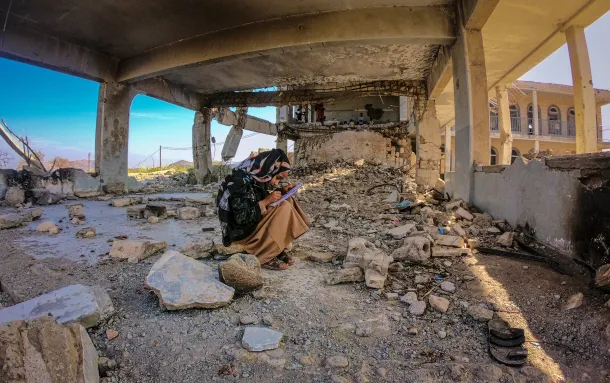
The latest global data reveal an alarming escalation in attacks on schools. In 2025, 1,680 attacks on schools were verified by the United Nations — a 33% increase from the 1,265 attacks recorded in 2024.
Nearly 80% of all crisis-affected out-of-school children — some 74 million — live in just 20 countries facing the world’s most severe crises. In these contexts, barriers to learning are steepest for the most vulnerable groups: 74% of refugee children, 52% of internally displaced children, and 45% of children with disabilities are out of school.
These consequences can persist long after crises end. The longer education is disrupted, the greater the risk that children may never return to school, and that girls in particular will face exploitation and abuse.
This trend reflects a broader deterioration in the protection of children in armed conflict. In 2025, the United Nations verified 38,558 grave violations against children, affecting 24,174 children — the highest figure since the monitoring mandate was established.
In response to these growing threats, UNESCO is mobilizing its partners on the ground in over 20 conflict- and crisis-affected countries to operate on three fronts: delivering concrete solutions to strengthen preparedness, ensuring learning continuity when schooling is disrupted, and supporting recovery once the immediate crisis abates.
Along these lines, UNESCO and its partners stand with communities amid widespread strain: supporting teachers and equipping schools with protective shelters in Ukraine; providing displaced children in Lebanon with mental health and psychosocial support through art and creative activities; enabling students in Gaza to continue learning via temporary learning spaces and the Gaza Virtual Campus; strengthening community schools in Haiti; rolling out early warning mechanisms in Nigeria; and reinforcing education data, planning and learning assessment systems in Yemen.
In April 2026, UNESCO’s Executive Board, chaired by Dr Nasser Bin Hamad Al Hinzab (Qatar), adopted a new Plan of Action to Protect Education from Attack. The plan provides a global framework for the Organization’s action in response to the rising number of attacks on schools and universities worldwide.
While these efforts help build the resilience of education systems, full respect for international humanitarian law remains essential. On this International Day to Protect Education from Attack, UNESCO calls on all parties to conflict to uphold their obligations under international law, fully implement United Nations Security Council Resolution 2601 (2021), and honour the commitments set out in the Safe Schools Declaration and the Nairobi Outcome Document, ensuring that all people everywhere can learn in safety and dignity.
With support from the Permanent Delegation of Qatar to UNESCO, UNESCO and the Education Above All Foundation (EAA) marked the seventh International Day to Protect Education from Attack by launching The Crossing, a temporary installation at UNESCO Headquarters that highlights the rising number of attacks on schools and the urgent need to protect education in times of crisis.



wydf@wydf.org.cn

