


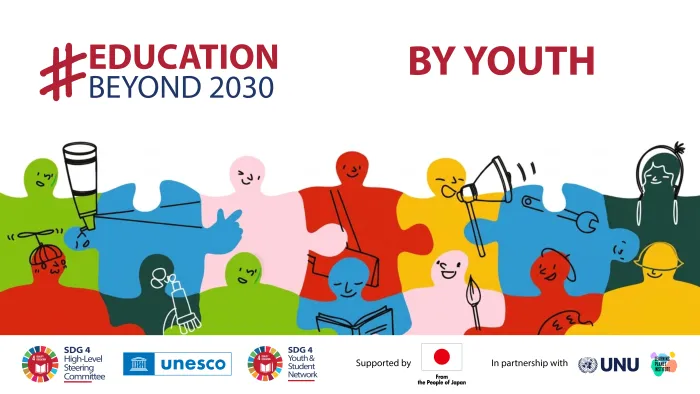
As we approach the deadline of the 2030 Agenda for Sustainable Development, the world has started reflecting on?what education should look like beyond 2030.
Young people are playing a leading role in this process. Throughout 2026, youth and students have shared their voices by taking part in an?online youth survey and regional and global consultation meetings.
More than 200,000 youth from 194 countries took part in this historic collective exercise. Almost one in four of them identified as belonging to a vulnerable group as defined by the United Nations. One in four responses included youth with disabilities.
In their responses, they portray the world and society they want and share how they would like education and learning to be adapted to meet this vision. They also present what they are ready to do, at their own level, to bring about this change.
Vision for the world and society
Young people want a just world for humans. They want sustainability and peace for the planet. And they are a very conscious generation with specific needs.
For them, a just world means above all quality education for all: an education that is free, public and accessible to everyone, regardless of background and without discrimination. They want a world based on equality, human rights and safety for all – where ‘safety’ is mainly defined by the freedom to be who they are and express their identities without judgement or fear of repercussions.
And they want dignified lives, where they can thrive and live well, have enough resources to live on and have access to basic services.
They deeply care about the planet. They believe a healthy planet is the basic condition for all their other aspirations. They care about peace, empathy and human connection, and they believe education is key to achieving peace and sustainability.
Two prominent topics stand out strongly for this generation. Young people see technology and artificial intelligence (AI) as very important, but also as dangerous if they are not ethical, human-centred, equally available to all, or if they are used without critical thinking. They are asking education to develop critical thinking and to teach them how to use AI responsibly. The second is mental health and well-being, which they consider as important as physical health.
Vision for education
Young people believe that since we live in a new world, we need a new education. School needs to be rethought, including what we learn and how we learn it.
For youth, schools and teachers are irreplaceable. School is a place for learning, but also for socialization: a place to meet people, make friends and interact with other humans. That matters a great deal to them, and it is why they believe teachers cannot be replaced by technology. They want real teachers who teach well and who help young people find the right path for their future. They believe teachers are instrumental in developing the critical thinking and skills needed to master AI, so that the latter is at the service of humans rather than in the driving seat of world dynamics.
They believe everyone should have equal access to education. They think the curriculum needs to be rethought. Reading, writing, mathematics and science remain essential, but many other topics are needed in today’s world, and beyond these foundations they would like to choose subjects based on their interests. They want to learn by doing, through a concrete education that teaches them how to act in real life and for the good of the planet and society.
They want schools to look after their mental health, with less stress and less pressure. They want exams to assess not what they have memorized, but what they can do and how much they have progressed. They also want better schools with better infrastructure.
Youth actions and support needed
In short, young people believe they are already doing a lot, but that they can also do more.
They can go further in using technology responsibly, both to learn and to teach. They commit to working together more and supporting others, promoting inclusion and well-being, especially for the most vulnerable students, such as students with disabilities and those living in poverty. They commit to doing more for the environment and to advocating and acting for change by taking part in decisions at school, national and international levels. They also commit to using arts, culture and sport?as ways of learning.
To carry out these commitments, young people need support from governments and schools, which should remain the main duty bearers?to ensure their vision of the world and education is implemented. They are asking for training, funding and tools for their activities. They want to be taken seriously: not only consulted, but truly included in decisions.
They need space for their activities, and time as well. School days are very long and homework is heavy, which leaves them little time for action for the planet and for others. They want to work more closely with adults, including teachers, community leaders and families, and to be supported by them, emotionally too.
Finally, they want to know what opportunities are available, to make what young people do more visible, and to have their actions officially recognized, including by their schools.
Taking youth voices to global leaders
In October 2026, a group of youth and students from all over the world, drawn from the SDG 4 Youth & Student Network hosted by UNESCO, the United Nations University youth networks and the Youth Committee of the Japanese National Commission for UNESCO, met in Tokyo, Japan, to translate these world visions and commitments into a ‘Youth agenda on education and learning beyond 2030’.
This document, which will be presented to world leaders at the Global Education Meeting in Bangkok from 31 March to 2 April 2027, will serve as a compass for a whole-of-society effort to set a new roadmap for an education that builds a world where young generations’ aspirations can be met.


wydf@wydf.org.cn

